Gallitzin Tunnels
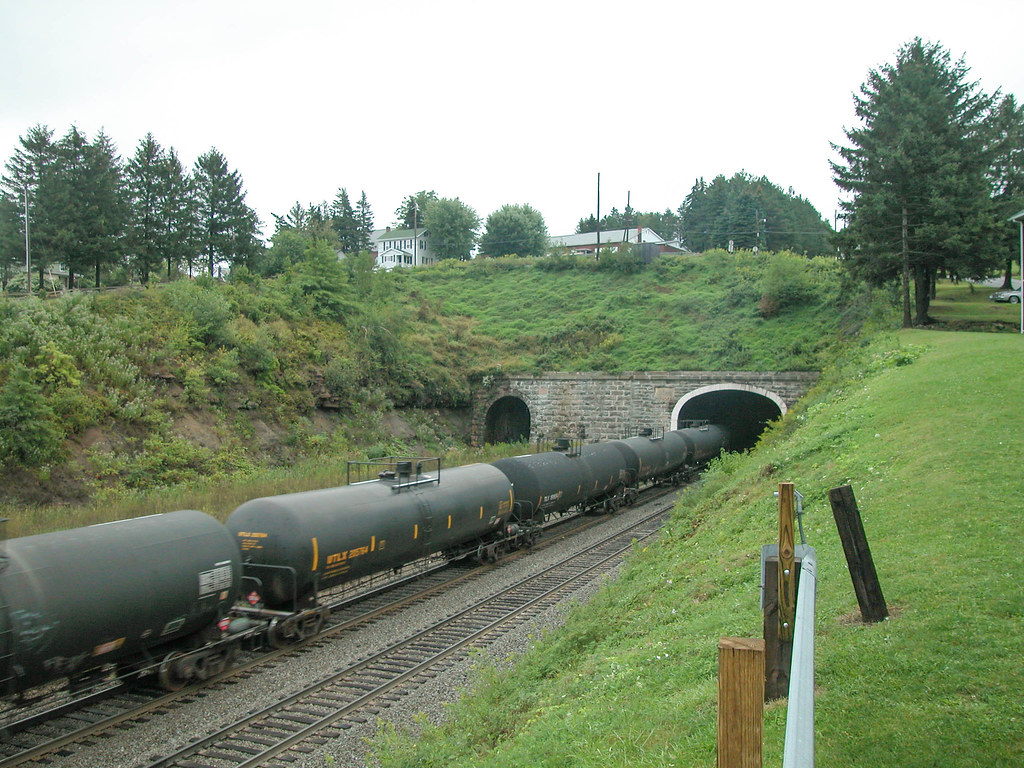
Three historic tunnels at the summit of the Alleghenies on Norfolk Southern's Pittsburgh Line (MP 248), with 50+ daily trains. Tunnels Park overlooks the west portals from downtown Gallitzin at 2,167 feet elevation.
Photos
Trainspotting Experience
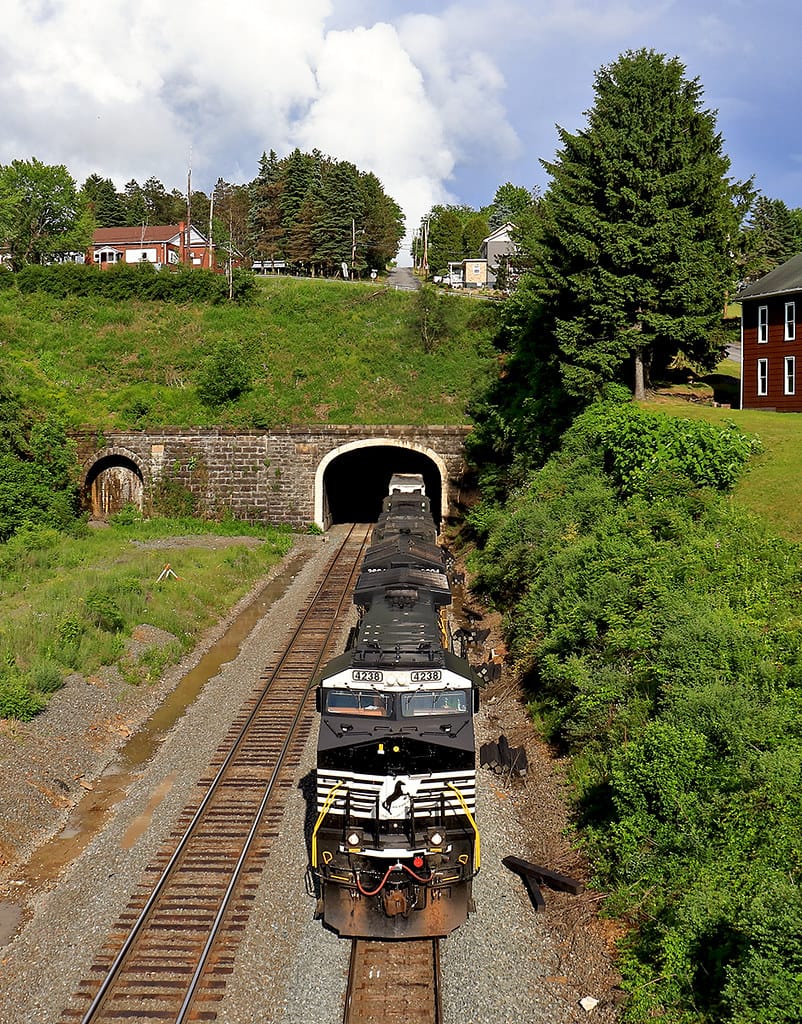
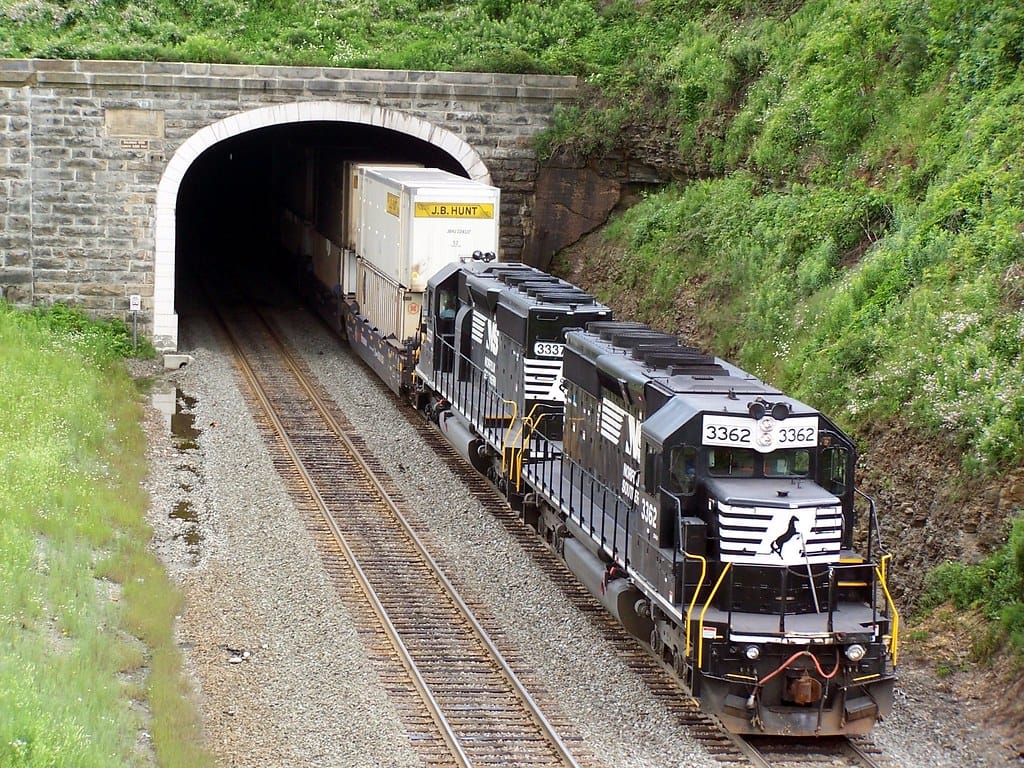
Gallitzin Tunnels Park sits on the elevated north side of Norfolk Southern's Pittsburgh Line at milepost 248, looking down at the double-track Allegheny Tunnel's west portal and the bricked-off Gallitzin Tunnel beside it. This is the summit of the Alleghenies at 2,167 feet above sea level — westbound trains have been grinding uphill at 1.85% grade for 12 miles from Altoona, and eastbounds are beginning their descent. The contrast in train behavior is dramatic: westbounds crawl past with locomotives straining and dynamic brakes cycling, while eastbounds accelerate away toward Horseshoe Curve with helpers dropping off at the Cresson engine terminal 3 miles west.
The Jackson Street bridge, immediately adjacent to the park, is the prime viewing perch. Pedestrian walkways on both sides have purpose-built cut-outs in the chain-link fence for photography and videography — the borough clearly welcomes railfans. From the bridge, you look straight down the bore of the Allegheny Tunnel and can watch headlights appear deep inside before the locomotive emerges. A restored 1942 PRR N5c caboose sits in the park and doubles as a seasonal visitors center staffed by volunteers. The Gallitzin Tunnels Museum, housed in the Borough Hall across Convent Street, has exhibits on the area's railroad, mining, and religious heritage.
Scanner frequency 160.800 lets you monitor Norfolk Southern dispatcher communications. Expect waits of 15-30 minutes between trains during busy periods, sometimes less.
Landscape, Setting & Local Atmosphere
Gallitzin sits at the crest of the Allegheny Front in Cambria County, straddling the Eastern Continental Divide. Water on the east side of town flows to the Chesapeake Bay via the Susquehanna River; water on the west side drains to the Gulf of Mexico via the Conemaugh and Ohio Rivers. The tunnels pierce through Allegheny Mountain at this narrow saddle point.
The park and Jackson Street bridge occupy a compact area in downtown Gallitzin, tucked between the borough's two prominent Catholic churches — a legacy of the town's Irish and Italian railroad and mining heritage. The town is named for Prince Demetrius Gallitzin, a Russian aristocrat turned Catholic priest who settled in nearby Loretto in 1789. The railroad cut is steep-walled here, with the closed Gallitzin Tunnel portal (bricked off since 1995) visible beside the active Allegheny Tunnel bore. Forested ridges surround the town on all sides, with hardwoods providing vivid fall color in October. Winters at this elevation can be harsh, with snow and cold temperatures creating dramatic exhaust plumes from idling locomotives.
Type & Frequency of Train Activity
Norfolk Southern's Pittsburgh Line is arguably the railroad's busiest freight corridor, connecting the Greater New York/New Jersey region with Chicago. Wikipedia and multiple sources cite 50 to 70 trains daily on this line. The Station Inn in nearby Cresson reports roughly 25-30 scheduled trains plus unscheduled unit trains of coal, crude oil, ethanol, and grain. RailfanLocations.com estimates about 45 trains per 24 hours visible at the tunnel location.
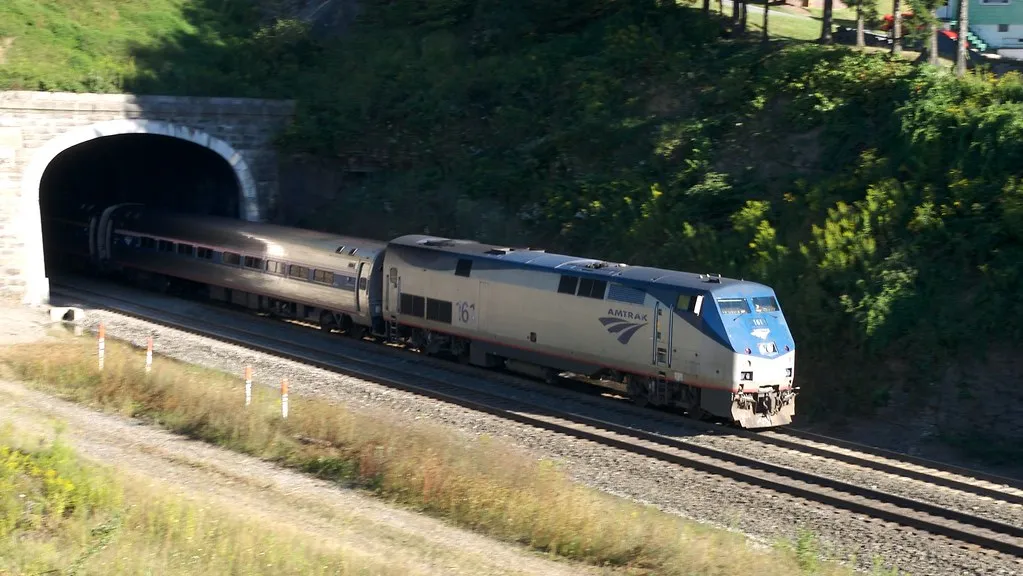
Traffic is predominantly Norfolk Southern freight: intermodal double-stack trains, mixed manifest freight, coal drags, autorack trains, and crude oil/ethanol unit trains. The Amtrak Pennsylvanian (trains 42/43) passes through twice daily on its Pittsburgh–Philadelphia–New York route, providing the only scheduled passenger service. Helper locomotives based at the Cresson engine terminal assist heavy trains over the mountain — this is the busiest helper district in the eastern United States, with grades reaching 1.85% westbound and the eastbound "Slide" track descending at 2.46% through the New Portage Tunnel at a maximum speed of 12 mph.
Three tracks approach the tunnels from the east: Tracks 2 and 3 pass through the double-tracked Allegheny Tunnel (bidirectional), while Track 1 passes through the single-track New Portage Tunnel (primarily eastbound). The third bore, the Gallitzin Tunnel, was closed in 1995 after the Allegheny Tunnel was enlarged for double-stack clearance.
Best Angles for Photos & What Railfans Enjoy Most
The two primary shooting positions are both in downtown Gallitzin and easily accessible on foot:
Jackson Street Bridge: The pedestrian walkways feature cut-outs in the chain-link fence specifically designed for cameras. From here you look directly into the Allegheny Tunnel bore — ideal for head-on shots of trains emerging from darkness. Both sides of the bridge offer different angles: the east side gives a view down the track approach and the tunnel portals, while the west side captures trains heading away through the rock cut. Morning light illuminates the west portal face.
Tunnels Park (Convent Street): The park sits on elevated ground on the north side of the tracks, giving a slightly elevated perspective looking down at the portals. Good for broadside shots and capturing the full scene including the closed Gallitzin Tunnel portal. The PRR caboose adds foreground interest.
East Portals (Bird Eye Road): For a less-visited perspective, the east portals of both active tunnels are reachable from Tunnel Hill via Bird Eye Road — a rough dirt track that requires a high-clearance vehicle, preferably with 4WD. This vantage offers the dramatic sight of trains plunging into or bursting out of the mountain from the opposite side.
Tunnelhill Street Overlook: An overlook just off Tunnelhill Street provides a broader eastern view of trains approaching or departing the tunnels, though vegetation can obstruct sightlines depending on the season. Fall and winter offer clearer views.
A 70-200mm zoom handles most compositions from the bridge, while a wider 24-70mm is useful for capturing the tunnel portal architecture in context.
Historical or Cultural Relevance
The Gallitzin Tunnels represent one of the most significant engineering achievements in American railroad history. Construction of the first bore — now known as the Allegheny Tunnel — began in 1849 under Engineer Thomas Seabrook and Contractor Thomas Rutter, employing some 400 Irish immigrants from County Cork. Progress was plagued by groundwater infiltration and an unstable 4-foot coal seam surrounded by weak shale and clay, requiring nearly the entire tunnel to be arch-lined for stability.
Completed on January 21, 1854, the Allegheny Tunnel (originally called Summit Tunnel) was the longest railroad tunnel in America at 3,612 feet and at 2,167 feet elevation. It was the final link completing the Pennsylvania Railroad's Mountain Division, enabling through rail service between Philadelphia and Pittsburgh without the inclined planes of the older Allegheny Portage Railroad. Combined with the simultaneously completed Horseshoe Curve 5 miles to the east, the tunnel transformed interstate commerce.
The New Portage Tunnel (1,620 feet), built by the Commonwealth of Pennsylvania as part of the New Portage Railroad, was completed in 1855 to the south. The PRR acquired it in 1857. The third bore, the Gallitzin Tunnel, was built between 1902 and 1904 to the north, expanding capacity to four tracks.
The tunnels' strategic importance drew hostile attention twice: a Confederate raid during the Civil War plotted to destroy them, and during World War II, German saboteurs landed by U-boat (Operation Pastorius) with the tunnels among their targets — the agents were captured before reaching Pennsylvania. In the early 1990s, Conrail enlarged the Allegheny and New Portage tunnels for double-stack container clearance. The Allegheny Tunnel reopened with two double-stack-capable tracks in September 1995, and the Gallitzin Tunnel was permanently closed.
What Makes This Spot Different
Gallitzin occupies an exceptionally rare position in American railroading: the summit of one of the most traffic-dense mountain crossings in the eastern United States, with infrastructure dating from 1854 still carrying 50+ trains daily. The combination of heavy tonnage, steep grades requiring helper service, and the confined tunnel approach creates an intensity of railroading that few locations can match.
What sets Gallitzin apart from other famous railfan spots like nearby Horseshoe Curve is the point-blank proximity. The Jackson Street bridge puts you directly above the tracks with purpose-built camera openings, and trains emerge from the Allegheny Tunnel just feet away. You experience the full spectrum of mountain railroading in a single visit — laboring westbound climbers, freewheeling eastbound descenders, helper cuts, and the twice-daily Amtrak Pennsylvanian — all concentrated at the continental watershed divide. The town itself embraces its railroad identity: the free park, volunteer-staffed museum, restored caboose, and photography-friendly bridge infrastructure make this one of the most welcoming railfan destinations in the country.
Frequently Asked Questions
QHow many trains pass through the Gallitzin Tunnels daily?
Norfolk Southern's Pittsburgh Line sees 50-70 trains per day, with approximately 45 movements visible at the tunnels in a 24-hour period. Traffic includes intermodal, manifest freight, coal, autorack, unit trains, and the twice-daily Amtrak Pennsylvanian.
QWhich tunnels are still active at Gallitzin?
Two of the three tunnels are active: the Allegheny Tunnel (double-tracked, enlarged for double-stack clearance in 1995) and the New Portage Tunnel (single track, primarily eastbound). The Gallitzin Tunnel was closed in 1995 and its west portal is now bricked off.
QIs there parking at Gallitzin Tunnels Park?
Yes, free street parking is available near the park. Use 548 Convent Street, Gallitzin, PA 16641 for GPS navigation. Look for the red PRR caboose to confirm you've found the park.
QWhere should I stay when visiting the Gallitzin Tunnels?
The Station Inn in Cresson, PA (3 miles west) is a railroad-themed B&B located 150 feet from the Norfolk Southern main line — the definitive railfan lodging in the area. Standard hotels are available in Altoona, about 12 miles east.
QAre there restrooms at Gallitzin Tunnels Park?
Yes, clean public restrooms are available in the Borough Hall building across Convent Street from the park, which also houses the Gallitzin Tunnels Museum.
QWhat scanner frequency should I use at Gallitzin?
Monitor 160.800 MHz for Norfolk Southern dispatcher communications on the Pittsburgh Line through this area.
Safety Tips
Stay off Norfolk Southern property at all times — observe from Tunnels Park, the Jackson Street bridge walkways, or other public areas. The tracks carry 50+ trains daily at varying speeds; eastbound trains on the "Slide" track can appear suddenly. If visiting the east portals via Bird Eye Road, the road is rough and unpaved — a high-clearance vehicle with 4WD is strongly recommended. Cell phone service can be limited in the mountain valleys around Gallitzin.
Seasonal Information
October offers peak fall foliage at this elevation. Winter temperatures can drop well below freezing with significant snowfall — the 2,167-foot elevation means conditions are often harsher than in nearby Altoona (1,000 feet lower). Summer days are generally mild with mountain breezes. The museum and caboose are staffed seasonally, primarily during summer months — check with the Borough for current hours.
Nearby Lodging
- The Station Inn
THE railfan lodging in the Alleghenies. Railroad-themed B&B in Cresson (3 miles west), 150 feet from the NS Pittsburgh Line. Front porch with rocking chairs overlooking mainline action. Family-style breakfast included. 827 Front Street, Cresson, PA 16630.
- Wingate by Wyndham Altoona
Modern hotel in downtown Altoona (~12 miles east) with pool, gym, and free breakfast. Convenient base for visiting both Horseshoe Curve and Gallitzin Tunnels.
- Fairfield Inn & Suites Altoona
Marriott property in Altoona with complimentary breakfast, indoor pool, and outdoor patio. 2915 Pleasant Valley Blvd, Altoona, PA 16602.
Nearby Attractions
8 miles / 13 km
Iconic 1854 three-track railroad curve with visitor center, museum, funicular, and trackside viewing area. Managed by the Railroaders Memorial Museum.
1.9 miles / 3 km
National Park Service site preserving the 1834 inclined-plane railroad that preceded the tunnels. Features the Lemon House tavern, Engine House #6, and the Skew Arch Bridge.
12 miles / 19 km
Museum celebrating the people behind the Pennsylvania Railroad. Exhibits on railroad workers and communities, with a pedestrian bridge railfan overlook behind the building.
10 miles / 16 km
Pedestrian-only bridge over the NS Pittsburgh Line offering expansive views of trains on a long straightaway between Gallitzin and Johnstown.
3 miles / 5 km
Trackside viewing platform in Cresson, 3 miles west, near the NS helper locomotive base. Good for watching helper operations and mainline traffic.
14 miles / 22 km
State park with camping, boating, and hiking on Glendale Lake. Named for the same Russian prince as the town of Gallitzin.
External Links
informative
official
informative
informative
informative
Looking for more spots? Browse the complete list of train spotting locations.
Quick Information
Country
USA
Region
Pennsylvania
City
Gallitzin
Spot Type
Tunnel Portal
Best Times
Trains run 24/7. Daylight hours offer the best photography. Morning light illuminates the west portals. The Amtrak Pennsylvanian passes through twice daily (once each direction). Museum and caboose open seasonally, staffed by volunteers during summer months.
Visit Duration
1-3 hours at Tunnels Park; a full day if combining with Horseshoe Curve, Cassandra Overlook, and Allegheny Portage Railroad NHS
Cost
Free. No admission fee for the park, bridge, or museum. Free street parking.
Train Activity
Train Types
Frequency
50-70 trains per day on the Pittsburgh Line corridor; approximately 45 movements visible at the tunnels in 24 hours
Access & Amenities
Parking
Available (Free street parking)
Shelter
Not available
Restrooms
Available