
Horseshoe Curve
America's most famous railroad curve — a 220-degree, three-track bend on Norfolk Southern's Pittsburgh Line, 5 miles west of Altoona. Built 1854, NHL since 1966. Around 50-60 trains daily.
Photos

Trainspotting Experience
Horseshoe Curve sits at milepost 242 on Norfolk Southern's Pittsburgh Line in Logan Township, Blair County, 5 miles west of Altoona. The visitor center at the base houses a gift shop, exhibits, and a raised-relief map of the Altoona-to-Johnstown corridor. From there you reach the trackside observation park via a recently reopened 288-foot funicular (back in service November 2024 after a $150,000 overhaul) or by climbing 194 stone steps — the equivalent of a 10-story building.
At track level, you stand inside the arc of the curve on a grassy terrace with picnic tables and benches, only yards from the three running tracks. Trains slow to a maximum 30 mph for freight and about 35 mph for passenger service, so each consist takes several minutes to work through the 2,375-foot curve. Long intermodal trains regularly exceed 8,000 feet, meaning the head end can exit one side of the curve before the tail has entered the other — creating an effect of being wrapped inside the train. The sound is immersive: horn echoes, dynamic brake whine, and constant flange squeal on the tight curvature. Ear protection is advisable during long sessions.
A scanner tuned to NS frequencies 160.800 (channel 46), 160.980 (channel 58), and 161.070 (channel 64) lets you track approaching traffic. The PT242.com train board provides real-time logs of movements at the curve. Admission is $13 for adults (2024), with discounts for youth, seniors, students, and military. A combo ticket with the Railroaders Memorial Museum downtown is available.
Landscape, Setting & Local Atmosphere
The curve wraps around Kittanning Point at roughly 1,594 to 1,716 feet elevation on the eastern slope of the Allegheny Mountains, gaining 122 feet through its 220-degree arc. Inside the bowl sits the highest of three Altoona Water Authority reservoirs, its still surface reflecting the forested ridgeline above. The Blair County Veterans Memorial Highway (SR 4008) tunnels directly beneath the curve on its way up the valley from Altoona.
Mixed Appalachian hardwoods — oak, maple, and hickory — blanket the surrounding slopes. Autumn foliage peaks in mid-October, framing dark Norfolk Southern locomotives in brilliant gold and crimson. Spring brings mountain laurel and rhododendron blooms. Winter occasionally dusts the rock cuts with snow, though the site is closed January through March. Summer mornings can produce fog in the lower Kittanning Run valley that burns off by midday, revealing long views east toward Altoona and the ridge-and-valley country beyond. The setting feels surprisingly remote for a location only 5 miles from a city of 44,000.
Type & Frequency of Train Activity
Norfolk Southern's Pittsburgh Line is arguably the railroad's busiest freight corridor. As of the most recent published data, 51 scheduled freight trains traverse the line daily — not including locals and helper engines, which can effectively double the number of movements. In 2012, Norfolk Southern reported 111.8 million short tons of annual traffic passing through the curve including locomotives.
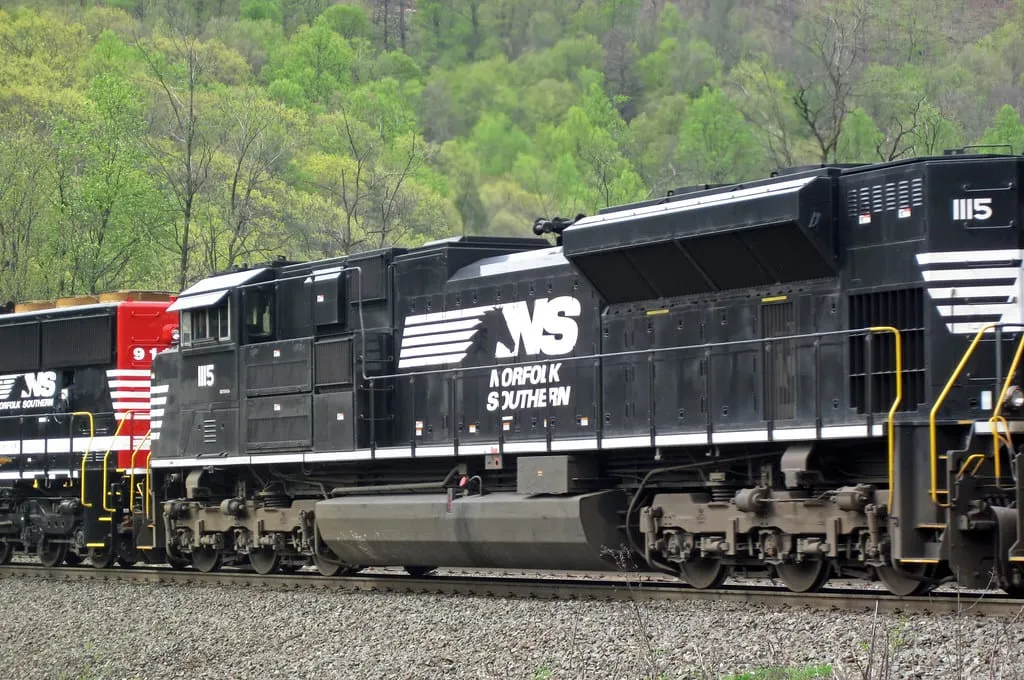
Freight consists include intermodal stack and trailer trains, mixed manifest, unit coal and coke trains, grain, tank car blocks, and auto racks. Motive power is primarily GE ES44AC and ET44AC units, with EMD SD70 variants also common. Heritage-painted NS commemorative units appear periodically. Helper locomotives based at Altoona and Cresson push heavy tonnage up the 1.8% grade; since 2020, 4,300-hp EMD SD70ACU locomotives have replaced the SD40E fleet in pusher service.
Amtrak's Pennsylvanian (trains 42/43) rounds the curve once each way daily on the New York–Pittsburgh route. The westbound typically passes through mid-morning, the eastbound in late afternoon. Amtrak conductors announce the curve to passengers, continuing a tradition that dates to the Pennsylvania Railroad era. On rare occasions, three trains can be seen rounding the curve simultaneously.
Best Angles for Photos & What Railfans Enjoy Most
The primary vantage is the upper terrace of the observation park, roughly 25-30 feet above rail level inside the arc of the curve. Morning light illuminates eastbound (descending) trains; by late afternoon the sun swings to favor westbound (climbing) consists. The mountain backdrop is to the south and west.
For the signature "train wrapping both sides" shot, position yourself midway along the fence near the center of the curve. When a 100+ car train occupies the full horseshoe, you can frame the head end on your left and the tail on your right with the reservoir and ridgeline centered. Telephoto lenses in the 100-300mm range compress the curve to show multiple locomotive sets in a single frame, while wide-angle (16-35mm) captures the full horseshoe geometry including the valley below.
Sunset silhouettes work well in summer when golden light filters through the tree canopy. Overcast days are forgiving since the rock cut walls reduce harsh shadows. Videographers appreciate the ability to pan 180 degrees from a single tripod position as a train works through the entire curve. The static display of PRR GP9 #7048 and the historic stone watchman's shanty provide foreground interest for wide compositions.
Historical or Cultural Relevance
Chief Engineer John Edgar Thomson designed the curve as the Pennsylvania Railroad's solution for crossing the Allegheny Front while maintaining a grade under 1.8%. Construction began in 1850, carried out by roughly 450 workers — mostly Irish immigrants — using only picks, shovels, horses, and drags. They cut through Kittanning Point and filled two ravines formed by Kittanning Run and Glenwhite Run. The single-track line from Altoona to Johnstown opened on February 15, 1854, at a total cost of $2,495,000 ($80,225 per mile), reducing Philadelphia-to-Pittsburgh travel time to 15 hours.
The first observation park was built in 1879 by leveling the interior of the curve — making it the oldest purpose-built train-watching site in America. A third track was added in 1898 and a fourth in 1900 to handle surging freight traffic. In 1893, a topographic model of the curve was displayed at the World's Columbian Exposition in Chicago.
During World War II, the curve became a high-priority military asset. In 1942, roughly 8,700 freight cars passed nearby Gallitzin daily — a train every 15 minutes. The curve was one of ten targets of Operation Pastorius, Hitler's plot to sabotage American infrastructure. Eight German agents landed by U-boat on Long Island and Florida beaches, but the mission collapsed when two saboteurs turned on the others and alerted the FBI. Six were executed. The curve was guarded by soldiers and closed to the public until May 1946.
Horseshoe Curve was designated a National Historic Landmark on November 13, 1966, and named a National Historic Civil Engineering Landmark by the ASCE in 2004. Conrail removed the fourth track in the late 1970s, and the current three-track configuration remains. In August 2012, Nickel Plate Road steam locomotive No. 765 became the first steam engine to traverse the curve since 1977, as part of Norfolk Southern's 21st Century Steam program.
What Makes This Spot Different
Horseshoe Curve is the oldest purpose-built train-watching location in North America, with a visitor park dating to 1879. The 220-degree geometry is extraordinarily tight for a main line handling 50-60 daily trains — the 9°15' curvature forces all traffic to 30 mph, giving prolonged, close-range views unlike any flat-terrain hotspot where trains flash past in seconds. The three-track configuration means multiple trains can occupy the curve simultaneously, and heavy helper operations on the 1.8% grade add extra locomotive action.
Its historical weight is unmatched among North American railfan sites: built in 1854 as one of the "engineering wonders of the world," targeted by Nazi saboteurs in WWII, and continuously operated under the Pennsylvania Railroad, Penn Central, Conrail, and now Norfolk Southern for over 170 years. The combination of a dedicated visitor center with a funicular, a live webcam streamed worldwide via Virtual Railfan on YouTube, a real-time train log at PT242.com, and proximity to other iconic rail sites (Gallitzin Tunnels 8 miles, Railroaders Memorial Museum 5 miles, Station Inn B&B 10 miles) makes the Altoona area the most concentrated railfan destination in the eastern United States.
Frequently Asked Questions
QHow much does it cost to visit Horseshoe Curve?
Admission is $13 for adults (2024 rate). Discounts are available for youth, seniors, college students, and military. A combo ticket with the Railroaders Memorial Museum in downtown Altoona is also available. The funicular ride is included with admission.
QIs the funicular operating?
Yes. The funicular reopened in November 2024 after a $150,000 overhaul and nearly five years out of service. Check the museum's Facebook page or call (814) 946-0834 ext. 2102 before visiting to confirm availability. Alternatively, you can climb the 194-step stairway.
QHow many trains pass through Horseshoe Curve each day?
Approximately 50-60 Norfolk Southern freight trains traverse the curve daily, plus two Amtrak Pennsylvanian passenger trains (one each direction) and numerous deadhead helper locomotive moves. The Virtual Railfan live stream and PT242.com train board can help you track activity in real time.
QWhen is Horseshoe Curve open to visitors?
The site typically operates April through November. Hours vary by season — generally Wednesday through Sunday from 9 AM to 4 PM or later. The site is closed January through March. Always check railroadcity.org or the museum's Facebook page for current hours before visiting.
QCan I ride a train through Horseshoe Curve?
You cannot board a train at the Curve itself, but Amtrak's Pennsylvanian (trains 42/43) traverses the curve daily between New York/Philadelphia and Pittsburgh. Board at Altoona or Johnstown stations. Conductors announce the curve to passengers.
Safety Tips
Stay behind the fence line at the observation park at all times. Three active main tracks carry 50-60 freight trains daily at up to 30 mph — trains are quieter than you expect on the curve due to electric traction motors and dynamic braking. Ear protection is recommended during extended viewing sessions; horn echoes and flange squeal are intense at close range. The 194-step stairway is steep — wear sturdy footwear and take breaks. Bring water in summer months; there is limited shade on the climb. The funicular is the accessible alternative but may not be running on all days.
Seasonal Information
April through November is the operating season. Autumn brings peak foliage around mid-October — the mixed hardwoods create a dramatic backdrop for photography. Summer provides the longest viewing hours but can be hot and humid on the exposed terrace. Spring weather is variable but mountain laurel blooms add color to the hillsides. Winter closes the site, but the Virtual Railfan live stream on YouTube provides year-round viewing from home. Weather at 1,600+ feet elevation is notably cooler and windier than the Altoona valley below; bring a layer even in summer mornings.
Nearby Lodging
- The Station Inn (Cresson)
The premier railfan B&B in America. Built in 1866, sits 150 feet from the NS Pittsburgh Line in Cresson. Front porch with rocking chairs overlooking the tracks. Family-style breakfast included. 10 miles from Horseshoe Curve.
- Fairfield Inn & Suites Altoona
Modern hotel off I-99 in Altoona with complimentary breakfast, indoor pool, and fitness center. About 10 minutes from the Curve. Recommended by Railroaders Memorial Museum.
- TownePlace Suites Altoona
Extended-stay option near I-99 in Altoona with full kitchens. Good for multi-day railfanning trips. Complimentary breakfast. About 10 minutes from the Curve.
- Wingate by Wyndham Altoona Downtown
Downtown Altoona hotel near Penn State Altoona campus. Walking distance to Railroaders Memorial Museum and RailWalk.
Nearby Attractions
5 miles / 8 km
Downtown Altoona museum celebrating railroad workers and the PRR legacy. Houses exhibits on the Altoona Shops, railroad labor history, and the K4s #1361 restoration project. Combo ticket available with Horseshoe Curve.
8 miles / 13 km
Railfan viewing area at the western portals of the historic Allegheny and New Portage tunnels, 8 miles west of Horseshoe Curve on the same NS Pittsburgh Line. Includes museum, restored N5C caboose, and Jackson Street overpass with photo cutouts.
12 miles / 19 km
National Park Service site preserving the 1834 Allegheny Portage Railroad — the inclined-plane system that preceded Horseshoe Curve. Free admission. Includes visitor center, Lemon House tavern, and remains of the inclines.
10 miles / 16 km
Eye-level trackside observation deck in Cresson with picnic pavilion and walk-through caboose. Located on the same NS main line, offering close-up views of freight and helper operations.
5 miles / 8 km
Purpose-built railfan promenade in downtown Altoona behind Station Medical Center, connected to overhead pedestrian bridges spanning the NS tracks. Covered shelters, benches, and lighting for evening viewing.
External Links
informative
informative
informative
Looking for more spots? Browse the complete list of train spotting locations.
Quick Information
Country
USA
Region
Pennsylvania
City
Altoona
Spot Type
Curve/Loop
Best Times
The site is open April through November (check railroadcity.org for exact hours). Early afternoon tends to concentrate traffic. Amtrak's Pennsylvanian passes westbound mid-morning and eastbound late afternoon. Arrive when the site opens for a full morning of activity.
Visit Duration
2-4 hours
Cost
Admission $13 adults (2024). Discounts for youth, seniors, students, military. Combo ticket with Railroaders Memorial Museum available. Free parking.
Train Activity
Train Types
Frequency
Approximately 50-60 Norfolk Southern freight trains per day (as of 2008, 51 scheduled freights not including locals and helpers), plus 2 daily Amtrak Pennsylvanian runs and numerous deadhead helper moves.
Access & Amenities
Parking
Available (Free parking at the base of the visitor center.)
Shelter
Not available
Restrooms
Available