Moffat Tunnel (West Portal)
Watch UP and BNSF trains emerge from the 6.2-mile Moffat Tunnel—the highest mainline railroad tunnel in the US at 9,239 ft—at Winter Park Resort's base area in the Colorado Rockies.
Photos
Trainspotting Experience
The West Portal of the Moffat Tunnel sits right at the base of Winter Park Resort, making it one of the most accessible high-altitude railfan locations in North America. To reach it, walk through the resort's staff/employee parking lots behind the ticket windows—there are no directional signs pointing to the tunnel, so first-time visitors may need to ask resort staff. UP surveillance cameras monitor both portals around the clock from the Harriman Dispatch Center in Omaha, and warning signs discourage approaching the tunnel mouth, but the viewing area is just yards from the tracks.
The tunnel is single-tracked, so trains alternate directions. After a train exits, the massive ventilation doors close and fans purge diesel exhaust before the next movement is cleared—a sensor system monitors particulate levels, and the wait is typically under 20 minutes for lighter trains. You'll hear the fans cycling between movements, a distinctive sound that signals activity. With only about 6 trains per 24-hour period as of recent years (down from 24-28 daily during the coal boom of the early 2010s), patience is required. Monitor UP frequency 160.455 MHz (from East Rocky westward) to track movements and avoid long waits between trains.
The tunnel sits at 9,239 feet—the highest point on the entire Amtrak network. At this altitude, weather changes fast: pack layers even in summer, and be prepared for afternoon thunderstorms from June through September. Snow can fall ten months of the year.
Landscape, Setting & Local Atmosphere
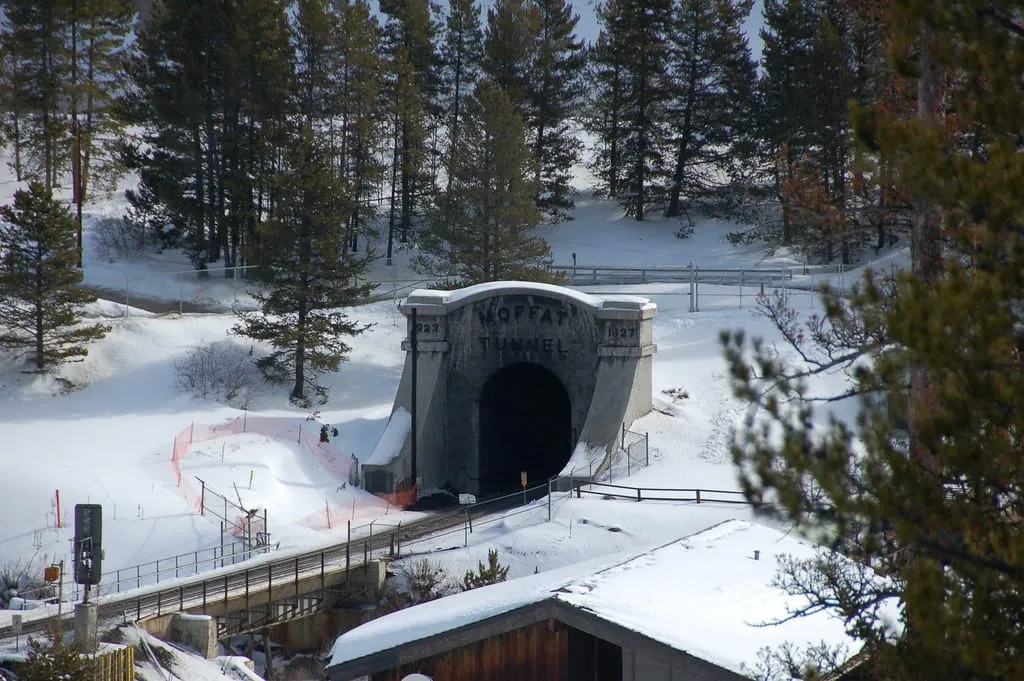
The West Portal opens into a broad clearing at the base of Winter Park Resort, with the Fraser Valley stretching westward below. At 9,239 feet above sea level and roughly 2,800 feet below the Continental Divide overhead, the setting is genuinely alpine. Lodgepole pine, Engelmann spruce, and subalpine fir frame the concrete portal structure, while James Peak (13,294 ft) and the surrounding Front Range ridgeline form the backdrop to the east.
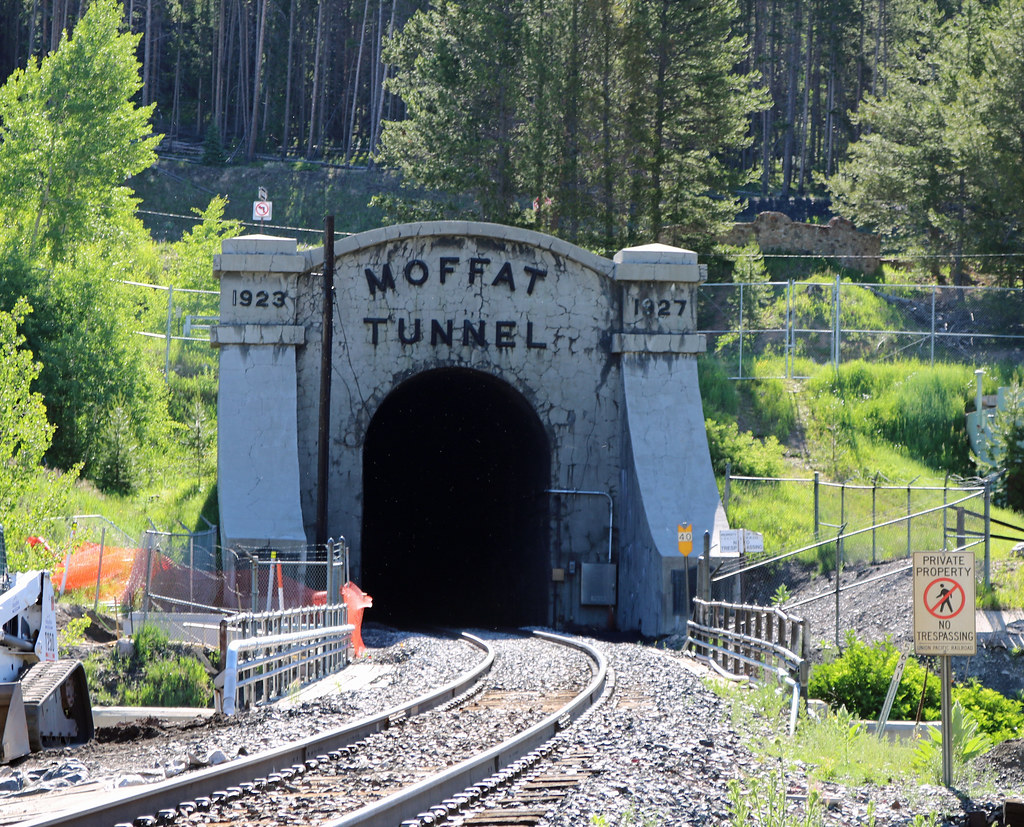
The portal itself retains its original 1920s concrete architecture with ornamental bronze lettering displaying the dates "1923" and "1927"—interestingly, the tunnel actually opened in 1928, but changing the bronze characters would have cost an additional $80 ($40 per portal), a sum the cash-strapped Moffat Tunnel Improvement District chose to save. The ventilation buildings and fan houses flanking the bore add an industrial counterpoint to the mountain scenery. A parallel water tunnel, bored alongside the railroad tunnel, still delivers water from the Colorado River basin to Denver—a dual-purpose engineering achievement that has operated since 1936.
Type & Frequency of Train Activity
Union Pacific dispatches the Moffat Tunnel Subdivision as part of its Denver Division. Current traffic averages approximately 6 trains per 24-hour period, a significant decline from the 24-28 daily movements during peak coal traffic in the early 2010s. The decline of coal mining in northwestern Colorado—only two mines remain active (the Energy Mine on the Craig Branch and the West Elk Mine on the North Fork Branch)—has dramatically reduced tonnage on this corridor.
Regular scheduled traffic includes: the daily westbound California Zephyr (Amtrak #5), the daily eastbound California Zephyr (Amtrak #6), a near-daily BNSF manifest between Denver and Provo, UT (HDENPVO/HPVODEN under trackage rights), and UP manifests between Denver and Grand Junction running roughly three times per week (MNYGJ/MGJNY). Additional coal and oil trains operate on an as-needed basis. During ski season (roughly December through March), the Amtrak-operated Winter Park Express runs up to five days per week, and the Rocky Mountaineer luxury tour train has used the tunnel since August 2021 on its Denver-to-Moab route.
Westbound freights typically run in 2x1 or 3x1 power configurations to handle the constant 2% grade from Denver, while BNSF's Provo manifest usually runs 3x0 without distributed power.
Best Angles for Photos & What Railfans Enjoy Most
The classic shot at the West Portal is the head-on view of a locomotive emerging from the tunnel bore, with the concrete arch and bronze lettering framing the engine. The portal faces roughly west-southwest, so morning light from the southeast illuminates approaching westbound trains beautifully—ideal for catching the California Zephyr around 10 AM. Afternoon light backlights westbound exits, creating dramatic silhouette opportunities.
From the resort base area, you can gain modest elevation by walking uphill on ski area service roads to the south side of the tracks, which provides a broadside perspective as trains curve away from the portal toward the Fraser Valley. A 70-200mm lens covers most compositions from the fence line; for tight portal shots, a 200-400mm range captures the locomotive framed in the tunnel opening.
In winter, skiers on the lower Mary Jane slopes have a bird's-eye view down to the tracks, though this requires telephoto lenses (300mm+) for meaningful railroad detail. The contrast of trains against fresh snow makes for compelling compositions. Note that drone use is restricted by both Winter Park Resort policies and Arapaho National Forest regulations.
Historical or Cultural Relevance
The Moffat Tunnel was the vision of David Halliday Moffat, a Denver financier who built the Denver, Northwestern & Pacific Railway beginning in 1902. His original route climbed over Rollins Pass at 11,660 feet via switchbacks with grades exceeding 4%—the highest standard-gauge mainline railroad ever built in the United States. Brutal winters and astronomical snow-removal costs made the pass unprofitable, but Moffat died in 1911 before securing financing for his tunnel.
Construction finally began on July 6, 1923, funded by bonds issued by the Moffat Tunnel Improvement District. Workers bored through James Peak from both ends, with a parallel pilot bore serving as a construction aid. The pilot bore was holed through on February 18, 1927—President Calvin Coolidge detonated the final blast by pressing a telegraph key from Washington, D.C., in a ceremony broadcast live by radio. The main railroad bore followed on July 7, 1927. The tunnel opened to rail traffic on February 26, 1928, at a final cost of nearly $24 million (over $370 million in today's dollars). Twenty-eight workers lost their lives during construction.
The tunnel is 24 feet high, 18 feet wide, and 6.2 miles long, with a ruling grade of 0.8% and an apex elevation of 9,239 feet. Combined with the Dotsero Cutoff completed in 1933, the route shortened the distance between Denver and the Pacific coast by 176 miles. The American Society of Civil Engineers designated the Moffat Tunnel a National Historic Civil Engineering Landmark in 1979. The tunnel's centennial falls on February 26, 2028.
What Makes This Spot Different
The Moffat Tunnel's West Portal offers a combination found nowhere else in North American railfanning: the highest mainline railroad tunnel in the United States (9,239 ft), located directly at a major ski resort base area. The tunnel is owned by the State of Colorado and leased to Union Pacific under a new 25-year agreement signed in 2025, which also opened the door for expanded Mountain Rail passenger service between Denver and Craig—potentially adding up to three daily roundtrips beyond the existing California Zephyr and Winter Park Express.
The parallel water tunnel, carrying Fraser River basin water to Denver since 1936, makes the Moffat Tunnel a rare dual-purpose infrastructure achievement. The original bronze portal lettering, ventilation buildings, and fan houses from the 1920s remain intact, giving the site genuine historical character. The upcoming centennial on February 26, 2028, will mark 100 years of continuous operation through the Continental Divide.
For railfans combining the hobby with other activities, Winter Park Resort offers world-class skiing in winter and mountain biking in summer, the Moffat Road Railroad Museum in nearby Granby preserves the line's heritage, and the Rollins Pass road (accessible in summer) traces the original 1902 right-of-way over the Continental Divide.
Frequently Asked Questions
QHow many trains per day pass through the Moffat Tunnel?
As of 2023-2025, approximately 6 trains per 24-hour period, including the daily Amtrak California Zephyr in each direction, BNSF and UP freight trains, and seasonal Winter Park Express and Rocky Mountaineer services. This is down significantly from 24-28 trains daily during peak coal traffic in the early 2010s.
QWhat scanner frequency should I use at the Moffat Tunnel?
Union Pacific frequency 160.455 MHz covers the Moffat Tunnel Subdivision from East Rocky westward through the tunnel. East of Rocky, the frequency is 160.320 MHz.
QWhen does the Amtrak California Zephyr pass through the West Portal?
The westbound California Zephyr (Train #5) typically emerges from the West Portal around 9:50-10:00 AM. The eastbound Zephyr (Train #6) enters the tunnel from the west side around 4:00-4:15 PM. Actual times vary with freight traffic and delays.
QIs the Winter Park Express still running?
Yes. For the 2025-2026 ski season, the Amtrak-operated Winter Park Express runs five days a week (Thursday-Monday) from late December through late March, departing Denver Union Station at 7:00 AM and returning from Winter Park at 4:35 PM.
QCan I walk up to the tunnel entrance?
No. Union Pacific monitors both portals with surveillance cameras linked to their dispatch center in Omaha. Warning signs prohibit approaching the tunnel mouth. Observe from behind the posted boundaries for both safety and legal reasons.
Safety Tips
The Moffat Tunnel is actively monitored by Union Pacific via closed-circuit cameras linked to the Harriman Dispatch Center in Omaha. Trespassing near or into the tunnel is illegal and extremely dangerous—there is zero clearance for a person alongside a train in the 18-foot-wide bore. Stay behind warning signs at all times. At 9,239 feet elevation, altitude sickness can affect visitors from lower elevations—symptoms include headache, shortness of breath, and fatigue. Drink plenty of water and avoid strenuous exertion if you feel ill. Lightning is a serious hazard during summer afternoon thunderstorms at this altitude. If thunder is audible, retreat to a vehicle or enclosed building immediately.
Seasonal Information
The West Portal is accessible year-round via Winter Park Resort, though conditions vary dramatically by season. **Winter (December-March)**: The busiest period for passenger trains, with the Winter Park Express running up to five days per week and bringing 275-500 passengers per trip. Deep snow blankets the area, creating photogenic compositions but requiring warm clothing at 9,200+ feet. Expect sub-zero temperatures and be prepared for altitude effects. **Spring (April-May)**: Shoulder season with fewer visitors. Snow may linger into May. The California Zephyr runs daily year-round. **Summer (June-September)**: Best weather for extended trackside waits, but afternoon thunderstorms are common and can develop rapidly. The resort area is busy with mountain biking and hiking. **Fall (September-October)**: Golden aspen color in the Fraser Valley provides a dramatic backdrop, though the display is brief at this elevation.
Nearby Lodging
- Winter Park Mountain Lodge
Directly across the street from Winter Park Resort ski lifts. 110 rooms with mountain views. Features Moffat Station Restaurant & Bar, indoor pool, and hot tubs.
- Winter Park Chateau
Boutique hotel in downtown Winter Park within walking distance of the Moffat Tunnel West Portal. Unique themed rooms, hot tub, and private bar.
- Best Western Alpenglo Lodge
Mid-range option in central Winter Park with pool, hot tub, fitness center, and restaurant. Short drive to resort and tunnel.
- Valley Hi Motel
Budget-friendly motel option in Fraser, a few miles west of Winter Park. Clean, simple rooms at lower elevation.
Nearby Attractions
18.6 miles / 30 km
Railroad museum in Granby featuring Colorado's largest permanent O scale Christmas train display, historic railroad equipment, and an HO scale replica of the Moffat Tunnel route being built.
74.5 miles / 120 km
Major railroad museum in Golden with 15-acre railyard, 100+ historic locomotives and cars, train rides, and extensive D&RGW collection. About 1.5 hours drive from Winter Park.
0.1 miles / 0.2 km
World-class ski resort directly adjacent to the West Portal. Skiing and snowboarding in winter; mountain biking, hiking, and Alpine Slide in summer.
3.1 miles / 5 km
Historic 1876 stagecoach stop and post office in Fraser, now a museum showcasing Grand County pioneer history. A short drive from the West Portal.
9.3 miles / 15 km
Summer-only gravel road tracing the original 1902 Moffat Road right-of-way over the Continental Divide at 11,660 ft. Accessible from Rollinsville on the east side. High-clearance vehicle recommended.
External Links
informative
informative
informative
official
informative
Looking for more spots? Browse the complete list of train spotting locations.
Quick Information
Country
USA
Region
Colorado
City
Winter Park
Spot Type
Tunnel Portal
Best Times
The westbound California Zephyr (Train #5) typically passes around 9:50-10:00 AM. The eastbound Zephyr (Train #6) enters the tunnel around 4:00-4:15 PM. During ski season (Dec-Mar), the Winter Park Express arrives mid-morning. Freight movements are unpredictable but often occur late evening or early morning.
Visit Duration
2-4 hours (allow extra time given low train frequency; bring a scanner to monitor for approaching trains)
Cost
Free access. Parking at Winter Park Resort base area is free outside ski season; during ski season, resort parking policies apply.
Train Activity
Train Types
Frequency
Approximately 6 trains per 24-hour period as of 2023-2025, down significantly from 24-28 daily during peak coal era (early 2010s). Includes daily Amtrak California Zephyr in each direction plus BNSF and UP manifest freights.
Access & Amenities
Parking
Available (Free parking at Winter Park Resort base area lots (shared with resort visitors). During ski season, closer lots may fill early.)
Shelter
Not available
Restrooms
Available