Raton Pass
Historic mountain pass on BNSF's Raton Subdivision at the Colorado–New Mexico border, where Amtrak's Southwest Chief climbs grades up to 3.5% through the 1908 tunnel at 7,588 ft elevation.
Photos
Trainspotting Experience
Raton Pass sits on the Colorado–New Mexico state line along BNSF's Raton Subdivision, the original Atchison, Topeka & Santa Fe transcontinental main line. The railroad climbs from Trinidad, Colorado (elevation ~6,000 ft) to the summit tunnel at 7,588 ft over roughly 10 miles of winding track, paralleling Interstate 25 and Raton Creek through a narrow canyon. Today the only regular traffic is Amtrak's Southwest Chief — trains #3 (westbound) and #4 (eastbound) — making this a low-volume, high-drama location where every passage counts.
Access for railfans is limited compared to busier corridors. I-25 parallels the tracks and several pull-offs along the highway afford glimpses of the railroad below, though many older access roads on the New Mexico side have been gated. The old Raton Pass Road, branching from Goat Hill in Raton, follows the historic Santa Fe Trail alignment and offers elevated vantage points, though vehicle access beyond the first gate is restricted — the road is walkable on foot. On the Colorado side, Exit 2 (Wootton) off I-25 is also gated. Railfans should plan around Amtrak's schedule and arrive early to scout legal vantage points along the interstate pull-offs.
Landscape, Setting & Local Atmosphere
The pass cuts through the Raton Range of the eastern Sangre de Cristo Mountains, a landscape of rust-colored sandstone outcrops, volcanic mesas, piñon-juniper woodland, and ponderosa pine. The terrain is semi-arid at nearly 7,800 ft elevation, with thin, crisp air that carries locomotive sounds for miles across the canyon.
To the south, the flat-topped mesas of northeastern New Mexico stretch to the horizon, while to the north the foothills roll toward Trinidad and the Spanish Peaks beyond. Summer brings vivid blue skies punctuated by afternoon thunderheads; winter can blanket the scene in snow, closing I-25 during severe storms. The overall atmosphere is one of isolation and rugged beauty — aside from interstate traffic, the surrounding country is sparsely populated ranchland unchanged in character since the Santa Fe Trail era.
Type & Frequency of Train Activity
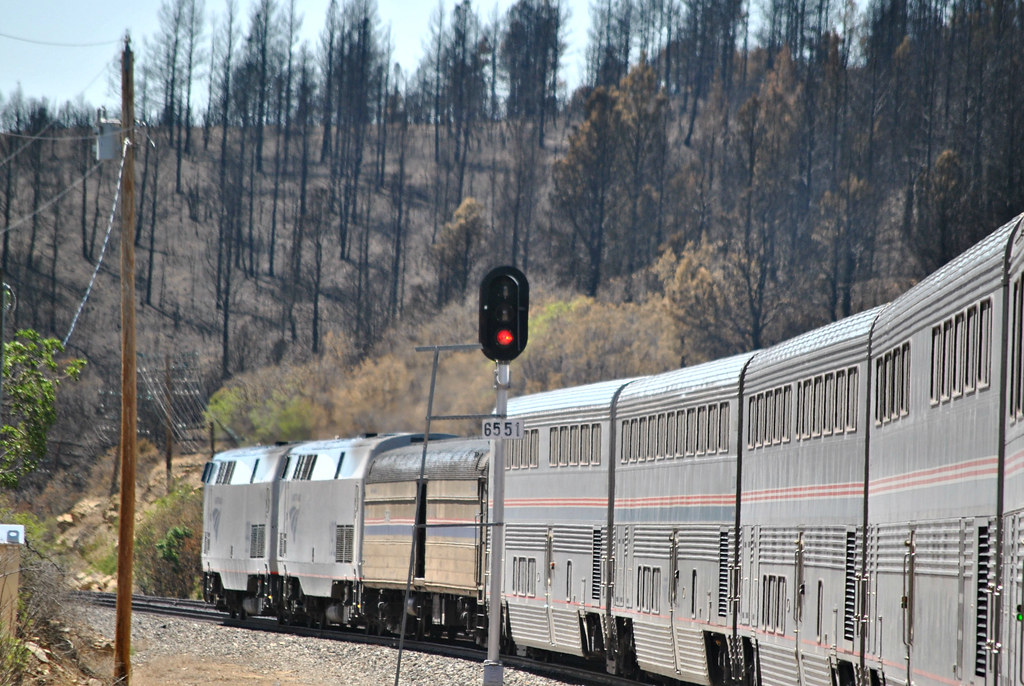
Regular traffic on BNSF's Raton Subdivision today consists solely of Amtrak's Southwest Chief, operating daily in each direction. The westbound #3 typically crosses the pass during mid-morning, climbing from Trinidad to the summit; the eastbound #4 descends the New Mexico side in early evening. Both run as Superliner consists hauled by pairs of GE P42DC or Siemens ALC-42 Charger locomotives.
BNSF ceased regular freight operations over Raton Pass in the early 2000s after the Belen Cutoff (opened 1908) had already diverted most transcontinental freight decades earlier. Today, occasional BNSF maintenance-of-way trains, ballast trains, or rare detour movements may appear, but these are unpredictable and may go weeks or months between occurrences. When freight does run, the steep 3.5% grades on the New Mexico side and up to 4% on the Colorado side force locomotives into full-throttle operation, producing dramatic audio and exhaust.
A notable feature of the Raton Subdivision is that it was home to some of the last active semaphore signals on a US Class I railroad — Union Switch & Signal type T-2 upper-quadrant semaphores dating from the 1920s. As of late 2022, BNSF has been replacing these historic signals, though a handful reportedly still stood at locations like Colmor and Wagon Mound further south on the subdivision.
Best Angles for Photos & What Railfans Enjoy Most
Photography on Raton Pass requires advance planning due to limited legal access points. The most practical vantage points include:
I-25 Summit Pull-off: At the Colorado–New Mexico state line, a highway pull-off near the "Welcome to Colorful Colorado" sign offers a view of the tracks emerging from the 1908 Raton Tunnel. A telephoto lens (200mm+) is useful here to compress the train against the tunnel portal and surrounding rock cuts. Morning light favors the westbound Chief on the New Mexico side; evening light is better for the Colorado descent.
Goat Hill Overlook (Raton): Accessible from Moulton Avenue off South 2nd Street in Raton, this city park sits at an elevated vantage above the town. While it's primarily a scenic overlook of the Santa Fe Trail route and surrounding mesas, it offers a distant but panoramic perspective of the railroad's climb out of Raton. Best for wide-angle establishing shots rather than tight train portraits.
I-25 Highway Parallels: Several spots where I-25 runs close to the railroad between Trinidad and the summit allow roadside photography from interstate shoulders or rest areas. Use extreme caution with highway traffic. The best compositions are where the railroad's tight curves contrast with the surrounding canyon walls and sandstone cliffs.
Compass orientation: the railroad runs roughly north-south through the pass, so morning sun illuminates the east-facing rock walls and afternoon sun the west side. Winter's low-angle light creates dramatic shadows in the canyon.
Historical or Cultural Relevance
Raton Pass has been a critical transportation corridor since the Santa Fe Trail era (1821–1880). Mountain man Richens "Uncle Dick" Wootton built a 27-mile toll road over the pass in 1865–66, charging wagons $1–$2 for passage. When the Atchison, Topeka & Santa Fe Railway decided to build west, company president William Barstow Strong dispatched engineers Albert Robinson and Ray Morley to secure the pass ahead of rival Denver & Rio Grande Railway in 1878. Morley befriended Wootton, who agreed to grant the Santa Fe right-of-way in exchange for lifetime railroad passes and groceries.
The AT&SF completed a temporary track with switchbacks and 6% grades in late 1878. A permanent 2,041-foot tunnel opened in September 1879. As traffic grew, a second 2,787-foot tunnel was completed in 1908, which remains in service today. That same year, the AT&SF opened the Belen Cutoff through central New Mexico, bypassing Raton's punishing grades for a maximum 1.25% gradient. Transcontinental freight shifted to the cutoff, though premier passenger trains — the Super Chief, El Capitan, and Grand Canyon Limited — continued over Raton for decades.
The pass was designated a National Historic Landmark in 1960 for its association with the Santa Fe Trail. It also saw military significance: Stephen Kearny's Army of the West crossed in 1846 during the Mexican-American War, and Colorado Volunteers marched over it in 1862 to reinforce Union forces at the Battle of Glorieta Pass.
What Makes This Spot Different
Raton Pass stands apart for what it represents rather than the volume of trains it offers. This is the steepest main line still in operation on a US Class I railroad, with grades reaching 3.5% on the New Mexico side and reportedly 4% on the Colorado approach — numbers that made it a perpetual operational headache for the Santa Fe and now BNSF. With barely two Amtrak trains daily and virtually no freight since BNSF ceased regular operations in the early 2000s, every passage of the Southwest Chief through the 1908 tunnel is an event worth waiting for.
The subdivision also gained fame among signal enthusiasts as the last refuge of mainline semaphore signals in the United States. The Union Switch & Signal T-2 upper-quadrant semaphores, installed in the 1920s, survived into the 2020s precisely because the low traffic didn't justify replacement — until PTC modernization and infrastructure upgrades finally caught up. The pass's dual significance as both a Santa Fe Trail and railroad landmark, recognized as a National Historic Landmark since 1960, makes it a uniquely layered destination for anyone interested in American transportation history.
Frequently Asked Questions
QHow many trains per day cross Raton Pass?
Currently, only two scheduled trains cross Raton Pass daily: Amtrak's westbound Southwest Chief (#3) and eastbound Southwest Chief (#4). BNSF ceased regular freight operations in the early 2000s, though rare maintenance or detour trains occasionally appear.
QCan you drive to the summit of Raton Pass?
Yes. Interstate 25 crosses Raton Pass at approximately 7,834 feet elevation. There is a pull-off area near the Colorado–New Mexico state line with a historic marker. The old Raton Pass Road from Goat Hill is accessible on foot but gated to vehicle traffic.
QWhat time does the Southwest Chief cross Raton Pass?
Schedules vary seasonally, but typically the westbound #3 crosses the pass during mid-morning hours and the eastbound #4 in early evening. Check amtrak.com for current timetables as times shift throughout the year.
QIs Raton Pass the same as the Santa Fe Trail?
Raton Pass was a key segment of the Mountain Branch of the Santa Fe Trail (1821–1880). The pass was designated a National Historic Landmark in 1960 for this association. Today, portions of the original trail route are still visible near the old Raton Pass Road.
QAre there still semaphore signals on the Raton Subdivision?
As of 2022, BNSF began actively replacing the historic Union Switch & Signal T-2 semaphores dating from the 1920s. A handful may still stand at locations like Colmor and Wagon Mound south of the pass, but their days are numbered. These were among the last active semaphores on a US Class I railroad.
Safety Tips
Raton Pass is traversed by Interstate 25, a busy highway prone to fast-moving traffic. Exercise extreme caution when using highway pull-offs for train photography — stay well back from travel lanes and never stop on the highway shoulder except at designated pull-off areas. Winter driving conditions can be hazardous, with I-25 subject to closures during severe storms. The elevation (nearly 7,900 ft at the highway summit) means thin air, intense UV radiation in summer, and rapid temperature drops. Carry water, sunscreen, and warm layers year-round. Rattlesnakes are present in warmer months. Stay off railroad property — the tracks, tunnel portals, and right-of-way are BNSF property.
Seasonal Information
Spring (April–May) and fall (September–October) offer the most comfortable conditions with mild temperatures, clear skies, and good photographic light. Summer brings warm days but frequent afternoon thunderstorms that can produce dramatic cloud backdrops or force you to shelter. Winter can be spectacular with snow-covered landscapes creating high contrast against dark rails and locomotive liveries, but I-25 closures due to blizzards are common and the pass can be inaccessible for days. The Southwest Chief runs year-round on a daily schedule regardless of season, though winter delays are more frequent.
Nearby Lodging
- Best Western Plus Raton Hotel
Full-service hotel off I-25 with indoor pool, restaurant (Mulligan's), free breakfast. 2 miles from Amtrak station. 74 rooms.
- Holiday Inn Express & Suites Raton
Modern hotel off I-25 with pool, fitness center, and complimentary breakfast. Good base for railfanning the pass.
- Microtel Inn & Suites by Wyndham Raton
Budget-friendly option at I-25 Exit 451, near Shuler Theater. Free breakfast and WiFi. Pet-friendly.
- Raton Pass Motor Inn
Charming 1950s-themed roadside motel with uniquely decorated rooms and vintage memorabilia. Convenient I-25 access.
Nearby Attractions
6.2 miles / 10 km
Local history museum housed in a 1906 building, featuring exhibits on the Santa Fe Trail, coal mining, and railroad heritage of Raton and Colfax County.
5 miles / 8 km
City park atop a hill overlooking Raton with panoramic views of the Santa Fe Trail route, surrounding mesas, and the railroad's climb. Features the iconic "RATON" sign and access to old Raton Pass Road.
12.4 miles / 20 km
State park northeast of Raton featuring a historic coal-mining camp, Lake Maloya, hiking trails, and wildlife viewing in a mountain setting at 6,950–8,350 ft elevation.
34 miles / 55 km
A 60,000-year-old cinder cone volcano with a paved road to the rim and hiking trails. On clear days, views extend into five states from the summit.
6.2 miles / 10 km
Historic 1930 atmospheric-style theater built as a medieval Spanish castle, now a state landmark hosting live performances in downtown Raton.
External Links
informative
informative
official
Looking for more spots? Browse the complete list of train spotting locations.
Quick Information
Country
USA
Region
New Mexico
City
Raton
Spot Type
Mountain Pass
Best Times
The westbound Southwest Chief (#3) crosses the pass during mid-morning hours; the eastbound (#4) passes in early evening. Confirm exact times on amtrak.com as schedules shift seasonally.
Visit Duration
2-4 hours (plan around Amtrak schedule)
Cost
Free access from I-25 pull-offs. No fees.
Train Activity
Train Types
Frequency
2 trains per day (Amtrak Southwest Chief #3 westbound and #4 eastbound). Occasional BNSF maintenance-of-way trains.
Access & Amenities
Parking
Available (Free parking at I-25 pull-offs and the state line rest area)
Shelter
Not available
Restrooms
Not available